Medically reviewed by Dr. Nathaniel Stroumza-Escoffier, plastic surgeon in Paris 8 — RPPS 10100674943. Last review: September 2026.
DEFINITION
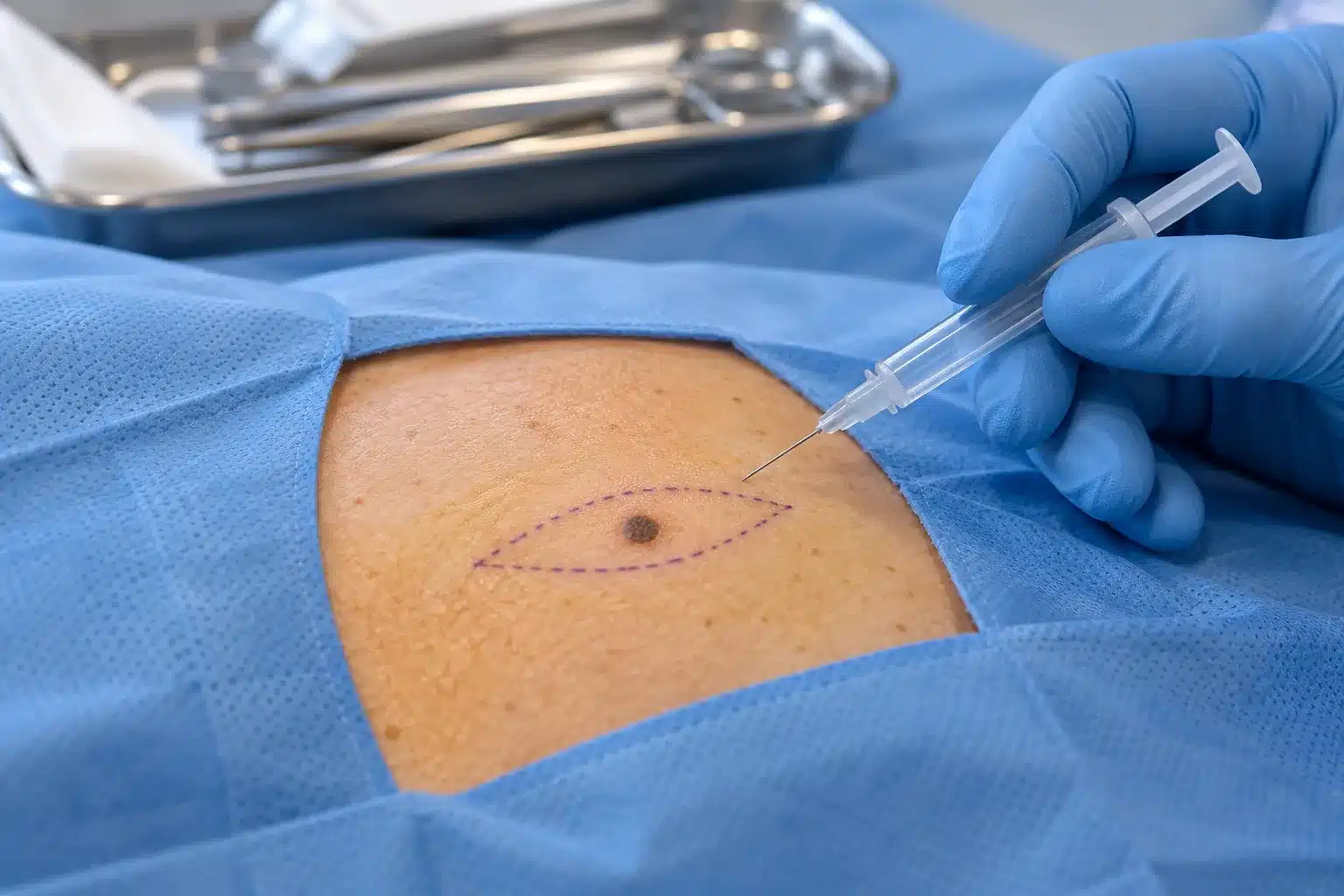
Skin surgery under local anesthesia involves removing a skin lesion (mole, cyst, lipoma, small tumor) by numbing only the area to be operated on, through an injection. This is the method of anesthesia used for most minor excisions in dermatological surgery.
SHORT ANSWER
You remain awake: only the area is numbed. Most small lesions are removed this way, without hospitalization, and you leave the same day with a bandage. The injection stings and burns for a few seconds; then you feel pressure or a pulling sensation, but the procedure is normally not painful.
KEY FIGURES
- A complication, most often minor, occurred in 6% of the 3,788 dermatological surgery procedures under local anesthesia (excluding sebaceous cysts); 22 procedures, less than 1%, required antibiotics or a repeat procedure (French prospective study). [1].
- Less than 1% of patients referred for suspected allergy to a local anesthetic had true immediate allergy (IgE) (review of 23 series, 2978 patients). [4].
- 0,89% of 1,911 patients experienced bleeding, while 46% of them were taking at least one anticoagulant or antiplatelet drug (38% only one, 8% two or more). [2].
TO REMEMBER
Report any treatment that thins the blood (anticoagulant, antiplatelet such as aspirin) and never stop it on your own: the decision is made with the surgeon and the doctor who prescribed it.
Before having a mole, cyst or lipoma removed, it is often the anesthesia that worries people, more than the procedure itself.
Does the procedure change depending on the injury?
The procedure depends on the size, depth, and location of the lesion. Each type of lesion has its own dedicated page.
| Spinal | Usual gesture | Page to consult |
|---|---|---|
| Mole (nevus) | Excision followed by closure, with analysis of the lesion | Removal of a mole |
| Cyst | Complete removal of the cyst and its wall, except in the case of an inflammatory flare-up | Cyst removal |
| lipoma | Complete excision of small lipomas, in the office or clinic | Lipoma surgery |
| Skin carcinoma | Excision with a margin of healthy skin, followed by suturing, grafting, or flapping. | Skin carcinoma surgery |
| Acrochordon | Removal with sterile scissors when excision is indicated | skin tags |
| Seborrheic keratosis | Excision is performed in some cases; other techniques exist (cryotherapy, curettage). | Seborrheic keratoses |
In what cases is local anesthesia insufficient?
- A large (more than 5 cm) or deep lipoma: prior MRI, and intervention sometimes under general anesthesia on an outpatient basis.
- Extensive reconstruction (large graft or flap).
- A patient who cannot remain still, or is very anxious: another approach to care is being considered.
- A documented allergy to a local anesthetic: an allergy consultation may be requested before the procedure.
The choice rests with the surgeon after the examination.
How to prepare: should you fast, stop your treatments, come accompanied?
Fasting. Fasting instructions will be given to you during your consultation: they take into account the planned procedure and any medication you may be taking for anxiety. Follow them precisely.
Medications. Bring a list of your medications, especially anticoagulants, antiplatelet drugs (including aspirin), and anti-inflammatories. For vitamin K antagonists (VKAs), the French National Authority for Health (HAS) classifies cutaneous surgery as a procedure with low and easily controlled bleeding. Surgery can be performed without stopping treatment if two conditions are met. The INR, checked before the procedure, must be between 2 and 3. No other medication or illness should disrupt coagulation [3] . This recommendation applies only to VKAs.
In an American series of 1,911 patients, those taking both clopidogrel and warfarin had 40 times more bleeding complications than others. The authors nevertheless recommend continuing these treatments to avoid thrombosis [2].
Assistance. Arrange for someone to drive you home if the dressing obstructs your vision or movement (eyelid, hand, foot) or after taking anti-anxiety medication: driving is then not recommended. Report any discomfort experienced during blood tests or at the dentist.
What does it feel like during local anesthesia?
A local anesthetic, usually lidocaine, is injected around the lesion with a fine needle. The prick and a brief burning sensation last a few seconds, then the area goes numb. During the procedure, you may feel pressure or a pulling sensation, but normally no pain. If you do experience pain, report it: the anesthesia can be administered further.
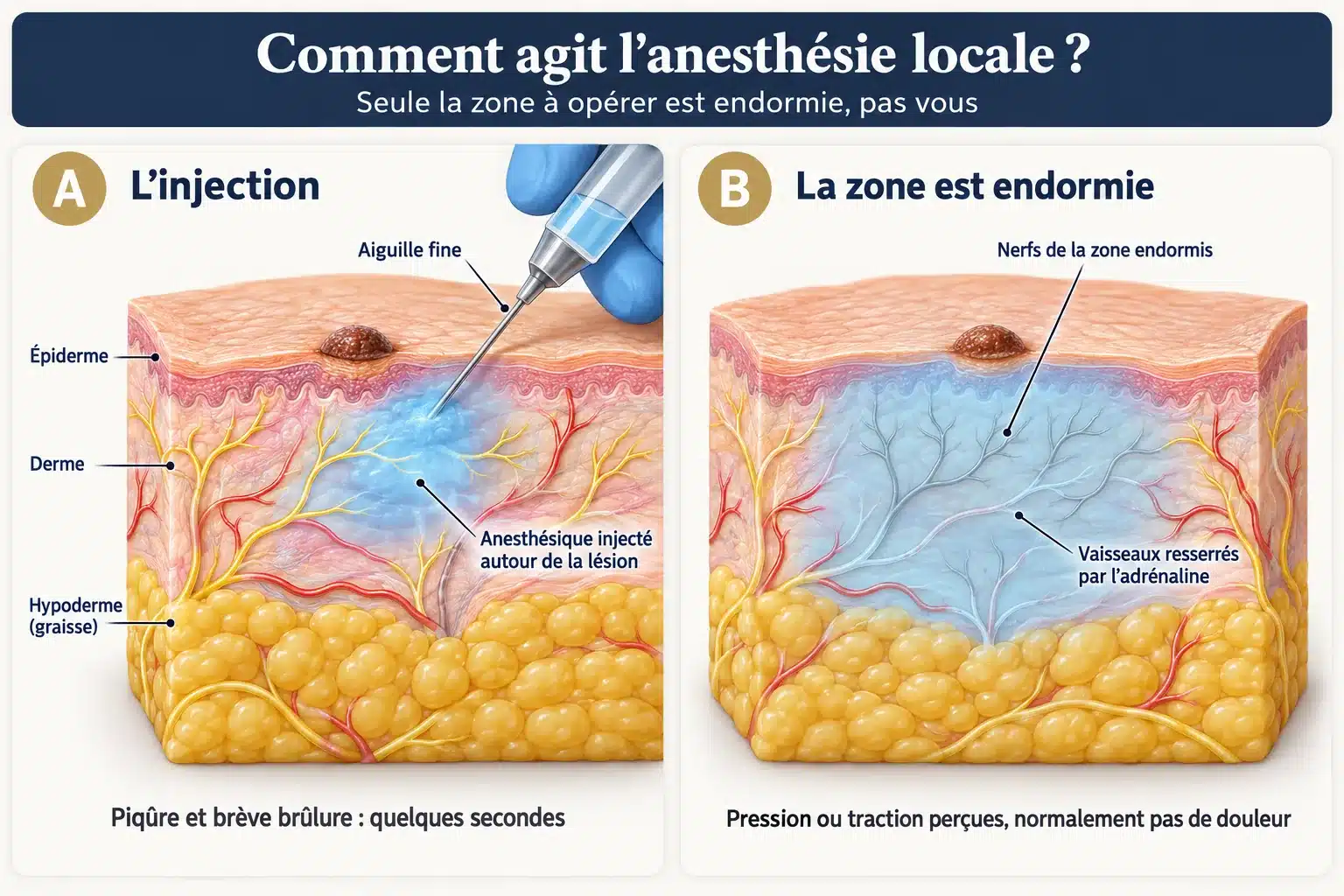
The product often contains a very low dose of adrenaline: it constricts small blood vessels, reducing wound bleeding and prolonging the anesthesia. Long discouraged for use in the nose and ear, it was used in this area on 10,201 patients in a German dermatology department, without any complications due to adrenaline [6] . Its effect develops gradually: in a trial of 12 volunteers injected in the arm, the amount of blood in the skin, measured by spectroscopy, was at its lowest on average 25,9 minutes after injection [7].
Can you be allergic to local anesthesia?
This is rare. A review of 23 series (2,978 patients referred for suspected allergy) found true immediate allergy (IgE) in only 29 of them, or less than 1% [4] . In a Danish allergy clinic, none of the 164 patients tested reacted to the provocation test; another allergen was found in 10% of them [5].
In skin surgery, most complications related to anesthesia are vasovagal reactions: 51 out of 54 in the French study [1] . This reaction (pallor, sweating, nausea, sometimes brief loss of consciousness) is not an allergy, nor are palpitations due to adrenaline. However, a past fainting spell, for example at the dentist, or an allergy documented by an allergist should still be reported before the procedure.
How does the session unfold, step by step?
- verifications : lesion to be removed, treatments, allergies, consent.
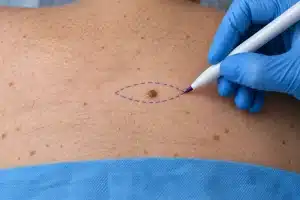
- Marking of the design, oriented according to the lines of tension in the skin.
- Disinfection and placement of a sterile field.
- Anesthesia by one or more injections.
- Excision, often spindle-shaped to close in a straight line.
- Hemostasis by compression or coagulation.
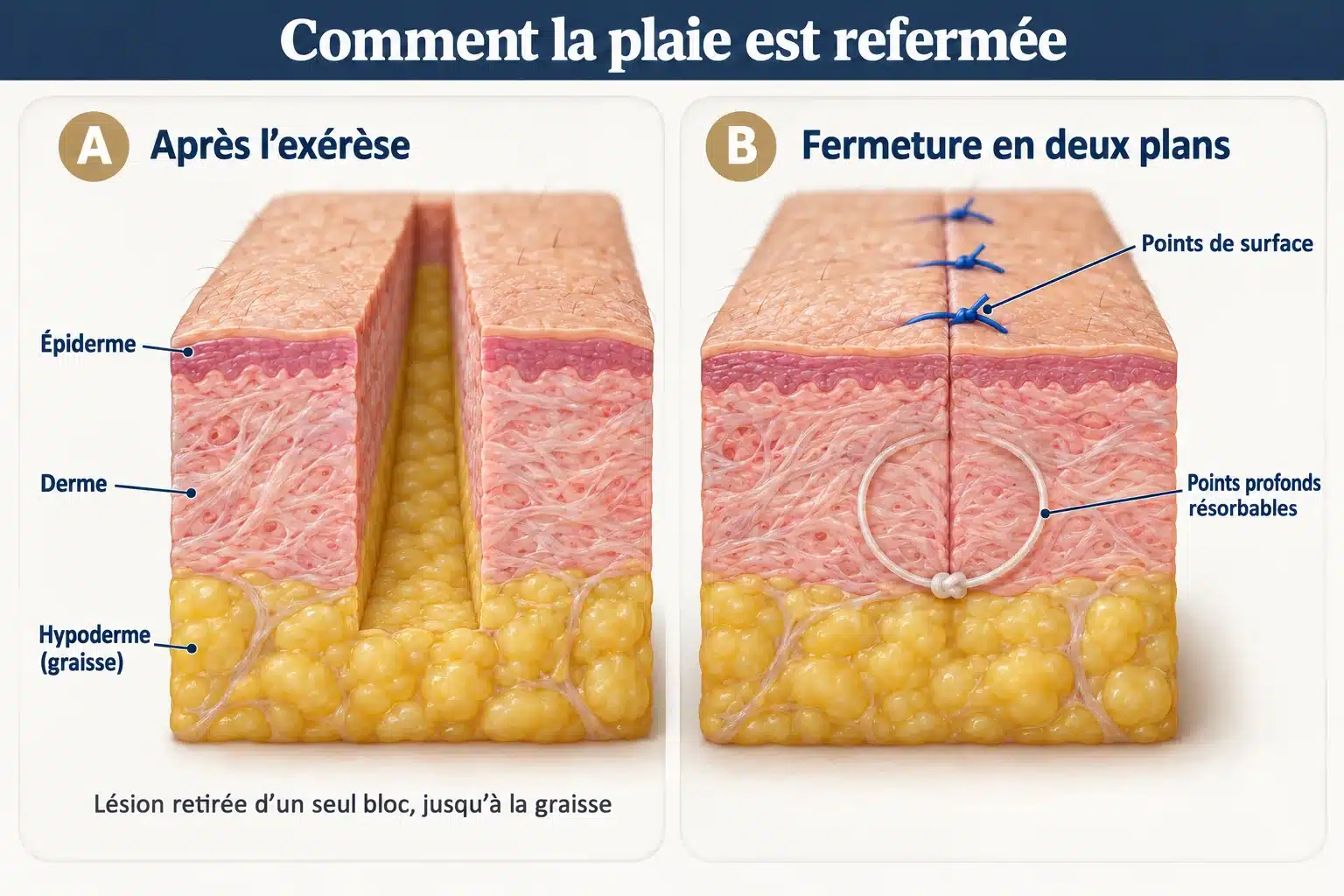
- Adjustable velcro closure by deep absorbable stitches and surface stitches or, if the skin loss is too great, by skin graft or local flap.
- Bandage and written instructions.
- Sending the part at the pathology laboratory: this is the rule for a mole or a lipoma; for other lesions, the surgeon will tell you.
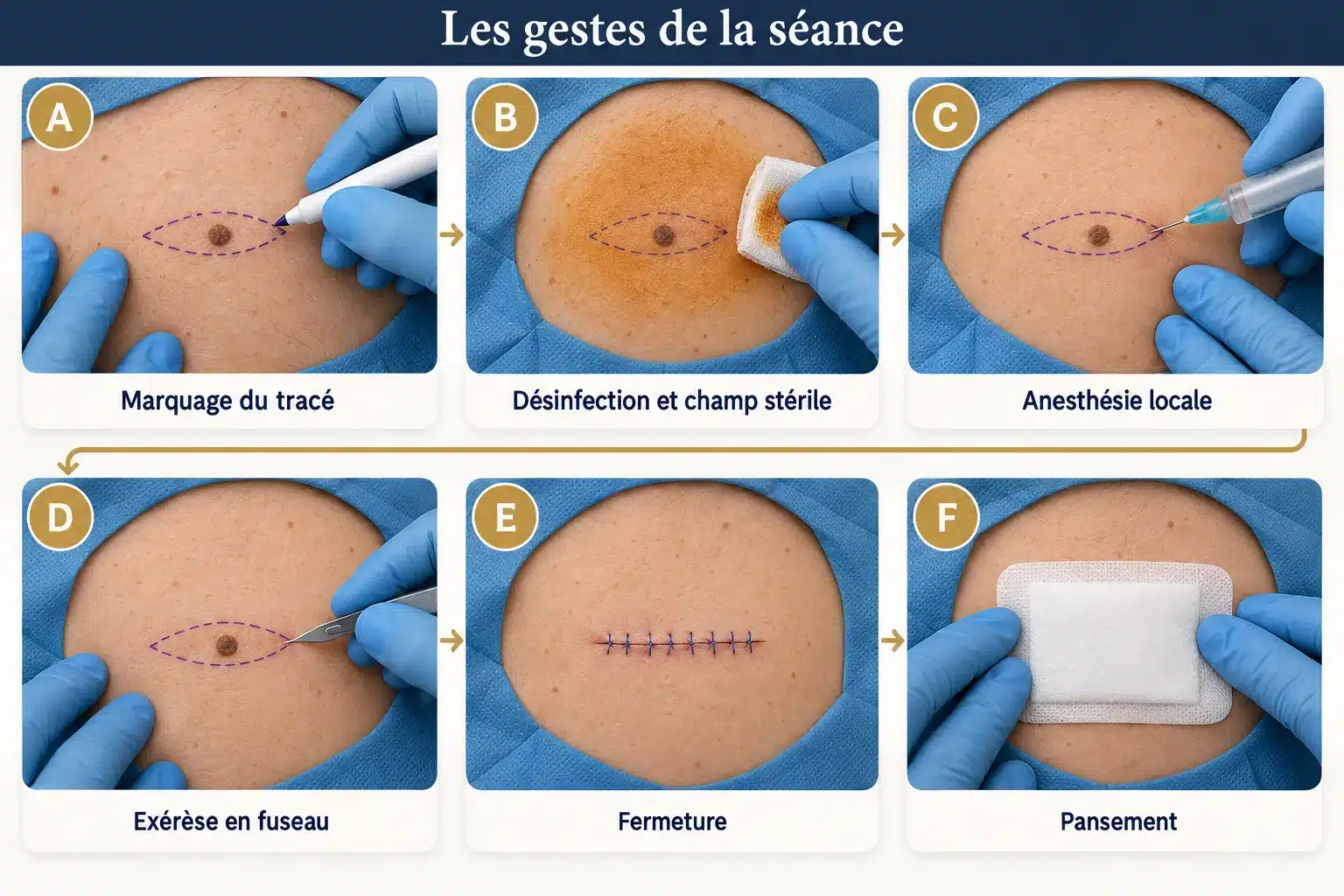
The duration ranges from a few minutes for a small excision to considerably longer for a flap or graft.
How do we receive the results of the analysis?
The pathologist examines the specimen under a microscope and writes a report: the nature of the lesion, the presence or absence of cancerous cells, and the margin of healthy skin left around the lesion. For cancer, this document also specifies the stage and guides any potential further treatment [9] . The results are given to you during a consultation after the procedure; the turnaround time depends on the laboratory. If a pigmented lesion concerns you, see the warning signs of a suspicious mole.
What happens next: pain, dressing change, shower, stitches, resumption of activities?
- Pain When the anesthesia wears off, some discomfort will appear, usually relieved by the prescribed painkillers. To ease the pain, do not add aspirin or anti-inflammatory medication without medical advice; if you take aspirin daily for your heart or blood vessels, do not stop taking it on your own. After a deeper excision, the area may remain sensitive for a few days.
- Shower and dressing A randomized trial involving 857 patients after minor skin excision showed that wetting the wound within the first 48 hours did not increase infection compared to keeping the wound dry and covered. [8]The cabinet's instructions remain the reference.
- Feed : absorbable, they disappear on their own; otherwise, they are removed after a period which depends on the area and which is indicated to you on the day of the procedure.
- Activities Avoid activities that strain the scar and protect it from the sun; see also how improve healing.
- Work stopping It is not systematic. It depends on the area, the size of the wound and your profession.
What are the risks of skin surgery under local anesthesia?
Like any surgery, skin excision carries risks, most often minor, but not always.
| Risque | Frequency observed | What limits it |
|---|---|---|
| Bleeding, hematoma | 3% of cases (France, 3,788 cases) [1] ; 0,89% bleeding rate (United States, 1,911 patients) [2] | Report any treatments, compression, dressing, and rest for the area. |
| Infection | 2% of patients, mostly superficial suppurations (92% of infections) [1] ; 1,3%, but more than 3% on the scalp, back, leg and genitals [2] | Asepsis, clean care, wound monitoring |
| Vasovagal syncope | 51 adverse events out of 3,788 procedures (approximately 1,3%), representing 51 of the 54 complications related to anesthesia. [1] | Movement while lying down, reported history, gradual mobilization |
| Partial necrosis of a graft or flap | 8,6% of grafts and 1,7% of flaps; 20% of scalp grafts and 10% of nose grafts [2] | Choice of technique, adherence to dressing and instructions |
| Dehiscence, enlarged, hypertrophic or keloid scar | Variable depending on the area and terrain | Traced along power lines, no early stress, sun protection |
| Recurrence of a cyst or lipoma | No figures were included in this article. | Complete excision, including the cyst wall |
A bothersome scar can be treated with scar revision.
When should the office be contacted again after the procedure?
Contact the firm again if you notice:
- bleeding that does not respond to firm and prolonged compression;
- rapid, tense or painful swelling, which may indicate a hematoma;
- a warm redness that spreads around the scar;
- a discharge of pus or fever;
- pain that increases instead of decreasing;
- a scar that is opening.
The office's contact details are on the contact page . In case of serious illness or breathing difficulties, call 15.
BOOK AN APPOINTMENT
Need a lesion removed? Dr. Stroumza-Escoffier will see you at her center in the 8th arrondissement of Paris to examine it and recommend the appropriate procedure. Make an appointment.
F.A.Q
How long does the effect of anesthesia last?
Numbness gradually dissipates over the following hours; adrenaline, when added to the product, prolongs this effect [6].
Can multiple lesions be removed in the same session?
Often, if they are small. The surgeon takes into account the total amount of anesthetic, which is limited, and the duration of the procedure.
Is it possible to swim (pool, sea) after the procedure?
Not until the wound has closed: the test mentioned above concerns a wet wound, not a prolonged bath. The surgeon will tell you when you can resume swimming.
Should we come without makeup or jewelry?
Regarding the area to be operated on, preferably yes: the skin must be clean before disinfection. The instructions given during the consultation specify this.
Is the procedure covered by insurance?
This depends on the procedure and its purpose, whether medical or cosmetic: see prices and reimbursements . The details will be explained during your consultation, where you will receive a personalized quote.
WARNING
This article provides information and is not a substitute for a consultation. The figures cited come from published studies, not from the findings of a consulting firm.
ABOUT THE AUTHOR
Dr. Nathaniel Stroumza-Escoffier is a plastic surgeon, qualified in plastic, reconstructive and aesthetic surgery, former head of clinic-assistant at the hospitals of Paris (RPPS 10100674943). He operates at the dermatological surgery center , 11 rue du Faubourg Saint-Honoré, Paris 8th arrondissement.
References
- Amici JM, Rogues AM, Lasheras A, et al. A prospective study of the incidence of complications associated with dermatological surgery. Br J Dermatol. 2005;153(5):967-71. French multicenter prospective study (84 dermatologists), 3,788 procedures, excluding sebaceous cysts and pyoderma. PMID 16225607. DOI 10.1111/j.1365-2133.2005.06861.x.
- Bordeaux JS, Martires KJ, Goldberg D, et al. Prospective evaluation of dermatologic surgery complications including patients on multiple antiplatelet and anticoagulant medications. J Am Acad Dermatol. 2011;65(3):576-83. Prospective single-center study, 1911 patients. PMID 21782278. DOI 10.1016/j.jaad.2011.02.012.
- High Authority for Health. Management of overdoses, situations at risk of bleeding, and bleeding accidents in patients treated with vitamin K antagonists in outpatient and hospital settingsSummary of recommendations, 2008.
- Bhole MV, Manson AL, Seneviratne SL, Misbah SA. IgE-mediated allergy to local anesthetics: separating fact from perception: a UK perspective. Br J Anaesth. 2012;108(6):903-11. Literature review, 23 series, 2978 patients. PMID 22593127. DOI 10.1093/bja/aes162. Erratum: Br J Anaesth. 2012; 109 (4): 669.
- Kvisselgaard AD, Mosbech HF, Fransson S, Garvey LH. Risk of immediate-type allergy to local anesthetics is overestimated: results from 5 years of provocation testing in a Danish allergy clinic. J Allergy Clin Immunol Pract. 2018;6(4):1217-23. Single-center retrospective study, 164 patients. PMID 28988784. DOI 10.1016/j.jaip.2017.08.010.
- Häfner HM, Röcken M, Breuninger H. Epinephrine-supplemented local anesthetics for ear and nose surgery: clinical use without complications in more than 10,000 surgical procedures. J Dtsch Dermatol Ges. 2005;3(3):195-9. Clinical series, 10,201 patients. PMID 16372813. DOI 10.1111/j.1610-0378.2005.04758.x.
- McKee DE, Lalonde DH, Thoma A, et al. Optimal time delay between epinephrine injection and incision to minimize bleeding. Plast Reconstr Surg. 2013;131(4):811-4. Triple-blind randomized trial, 12 volunteers. PMID 23249984. DOI 10.1097/PRS.0b013e3182818ced.
- Heal C, Buettner P, Raasch B, et al. Can sutures get wet? Prospective randomized controlled trial of wound management in general practice. BMJ2006;332(7549):1053-6. Multicenter randomized trial, 857 patients. PMID 16636023. DOI 10.1136/bmj.38800.628704.AE.
- National Cancer Institute. Post-operative follow-upUpdated on 1er April 2015.
This article is for informational purposes only and does not replace a medical consultation.