Medically reviewed by Dr. Nathaniel Stroumza-Escoffier, plastic surgeon in Paris 8 — RPPS 10100674943. Last review: September 2026.
DEFINITION
A dermatologist is a medical specialist in skin diseases. A plastic surgeon is a qualified surgeon specializing in plastic, reconstructive, and cosmetic surgery, and an expert in tissue repair.
SHORT ANSWER
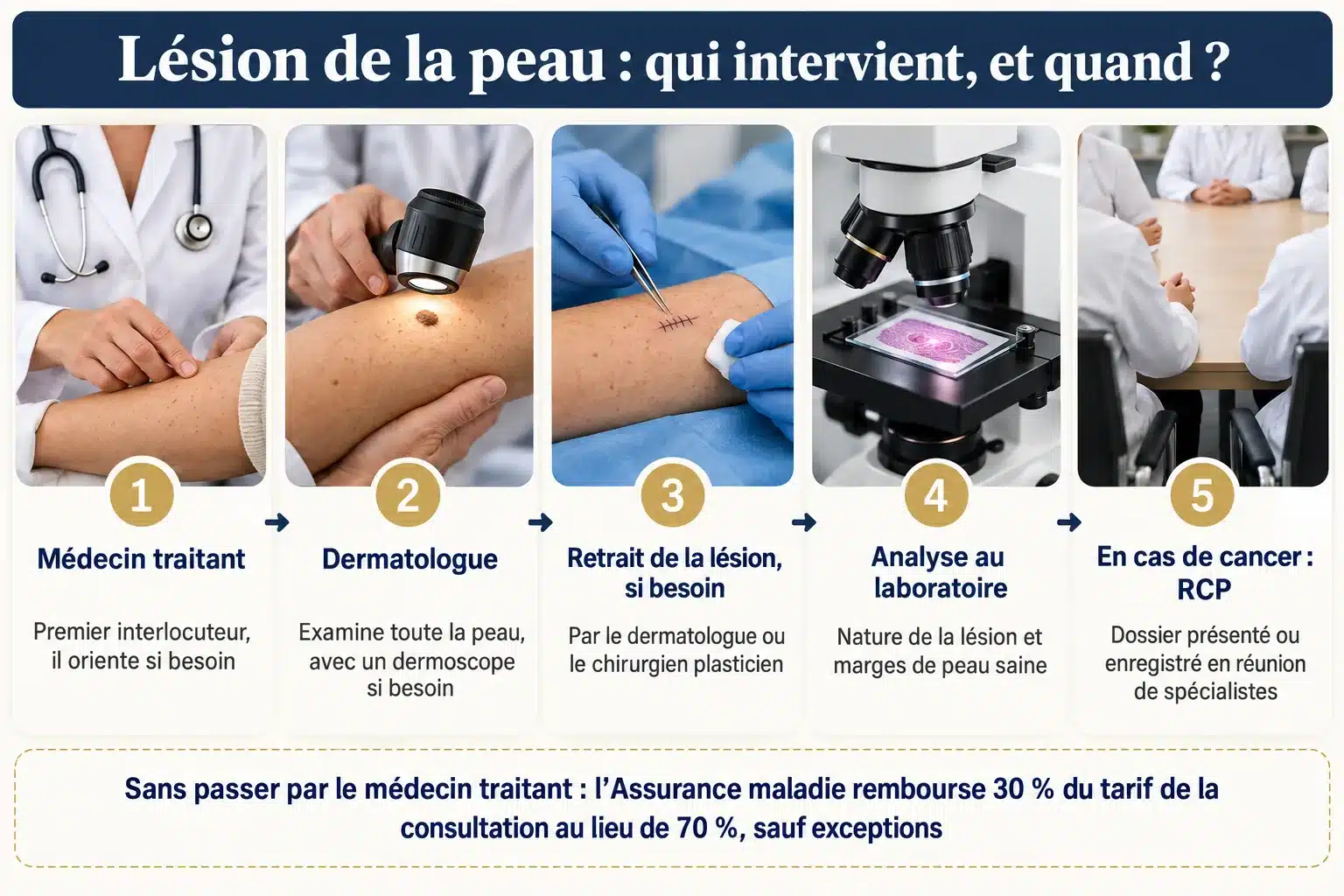
To have a skin lesion examined, first consult your general practitioner or a dermatologist. If the lesion needs to be removed with a safety margin, or if the wound requires closure or reconstruction, especially on the face, a plastic surgeon can take over. In the case of cancer, the case is discussed, or at least recorded, in a multidisciplinary team meeting.
Dermatologist, plastic surgeon, general practitioner: who does what for the skin?
When faced with a skin lesion, it is not always clear which door to turn to: dermatologist, "dermatological surgeon", plastic surgeon? In practice, dermatological surgery involves several doctors whose roles complement each other.
- The attending physician is your first point of contact. If they observe a suspicious lesion, they will refer you to a dermatologist for further examination.[1][3].
- The dermatologist According to the National Cancer Institute (INCa), a dermatologist is "the specialist in skin diseases." They examine the entire body, confirm or rule out a suspicion of cancer, and remove any suspicious lesions if deemed necessary.[3][4].
- The plastic surgeon This is involved when the removal of a lesion raises a question of repair: safety margin, area difficult to close, very visible scar.
What does a dermatologist do when faced with a skin lesion?
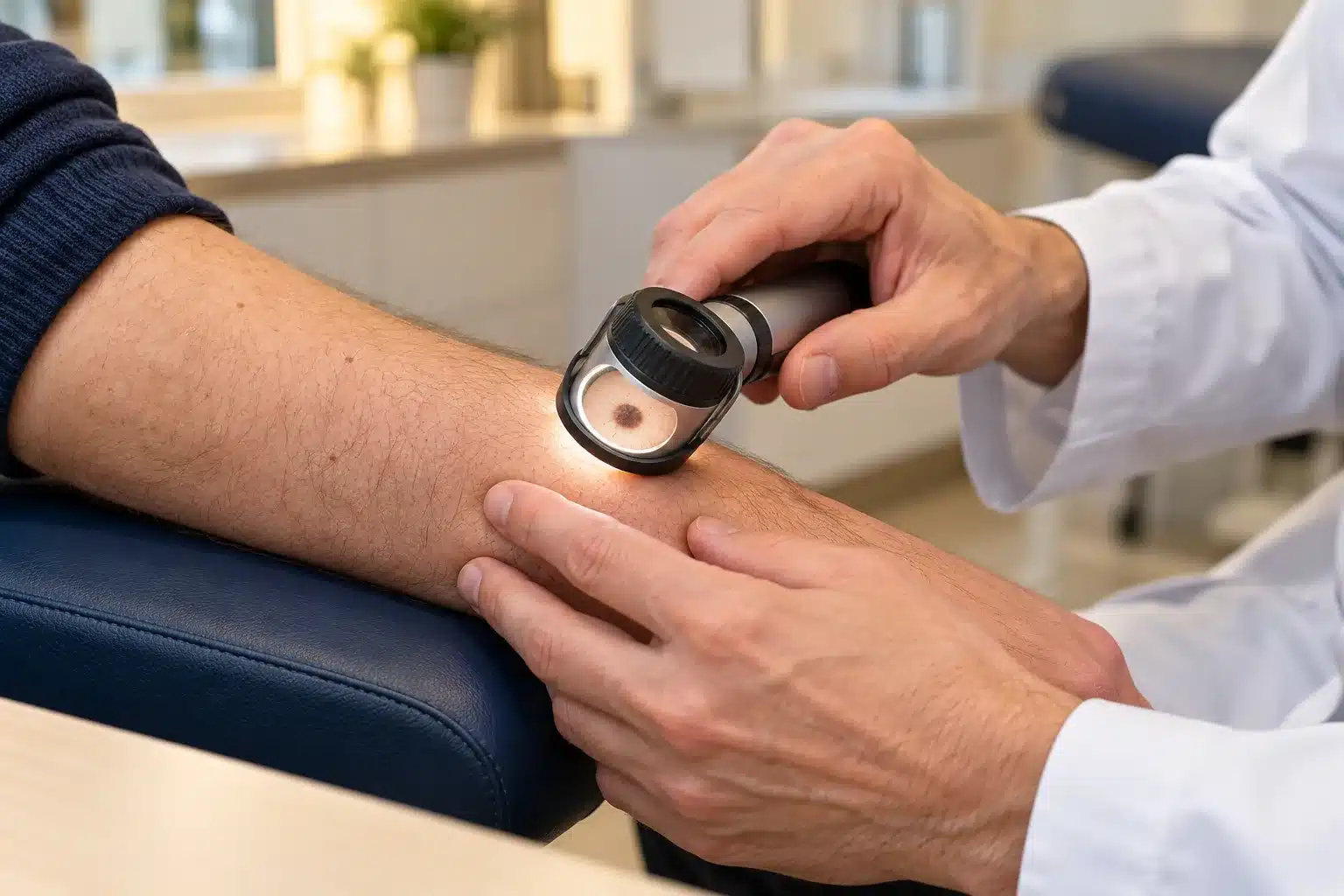
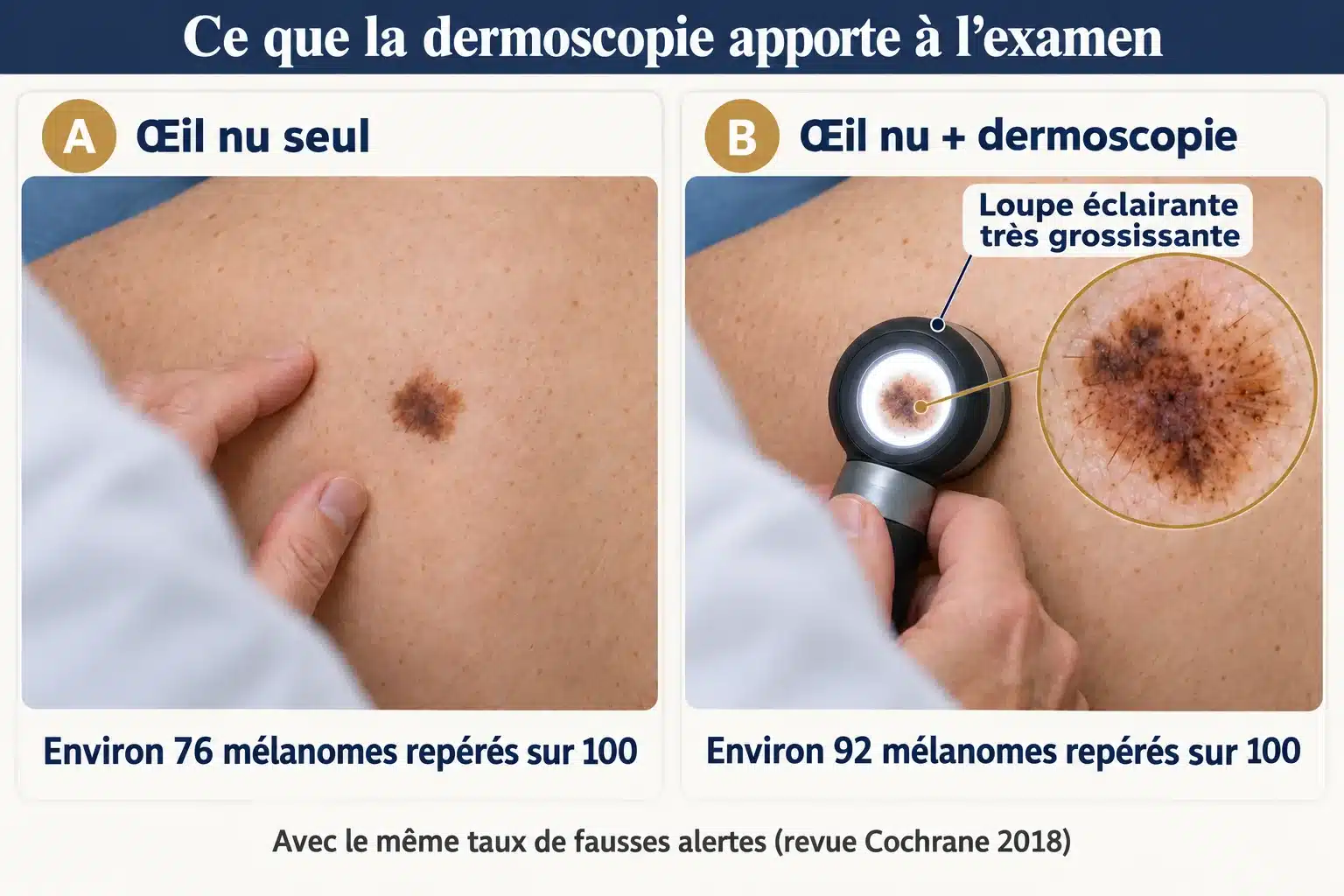
The dermatologist examines the entire skin, not just the lesion that brought you in. If necessary, they may use a dermatoscope, a magnifying glass with a light and high magnification, and, if you have many moles, they may photograph them to monitor their changes [4] . This examination is central to mole screening.
If you notice a suspicious lesion, he will suggest either monitoring it or removing it under local anesthesia for analysis. According to the INCa (National Cancer Institute), this procedure can take place in his office or at the hospital, without hospitalization [4] . He will also assess how often your skin needs to be monitored [4].
KEY FIGURES
- Out of 100 melanomas, examination with the naked eye supplemented by dermoscopy detected approximately 92 in consultation, compared to 76 with the naked eye alone, with an identical false alarm rate (Cochrane review: 26 assessments and 23,169 lesions with dermoscopy, 13 assessments and 6,740 lesions without).[7].
- Dermoscopy was more effective in experienced hands; data in general practice remain limited.[7].
- People at risk: according to the INCa (National Cancer Institute), it is generally recommended to have your skin examined at least once a year and to perform a self-examination every three months.[4].
When is the opinion of a plastic surgeon useful?
Removing a lesion creates a loss of skin that must be closed. The opinion of a plastic surgeon is helpful when this repair becomes the core of the problem.
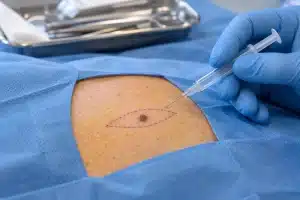
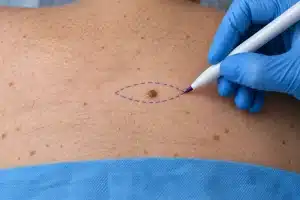
- another extended excisionThis means surgical removal with a margin of healthy skin, for example in the case of melanoma: the size of this margin depends on the thickness of the tumor and its location, particularly on the face or extremities.[5] ;
- a lesion located where skin is missing and the scar is visible: nose, eyelids, lips, ears.
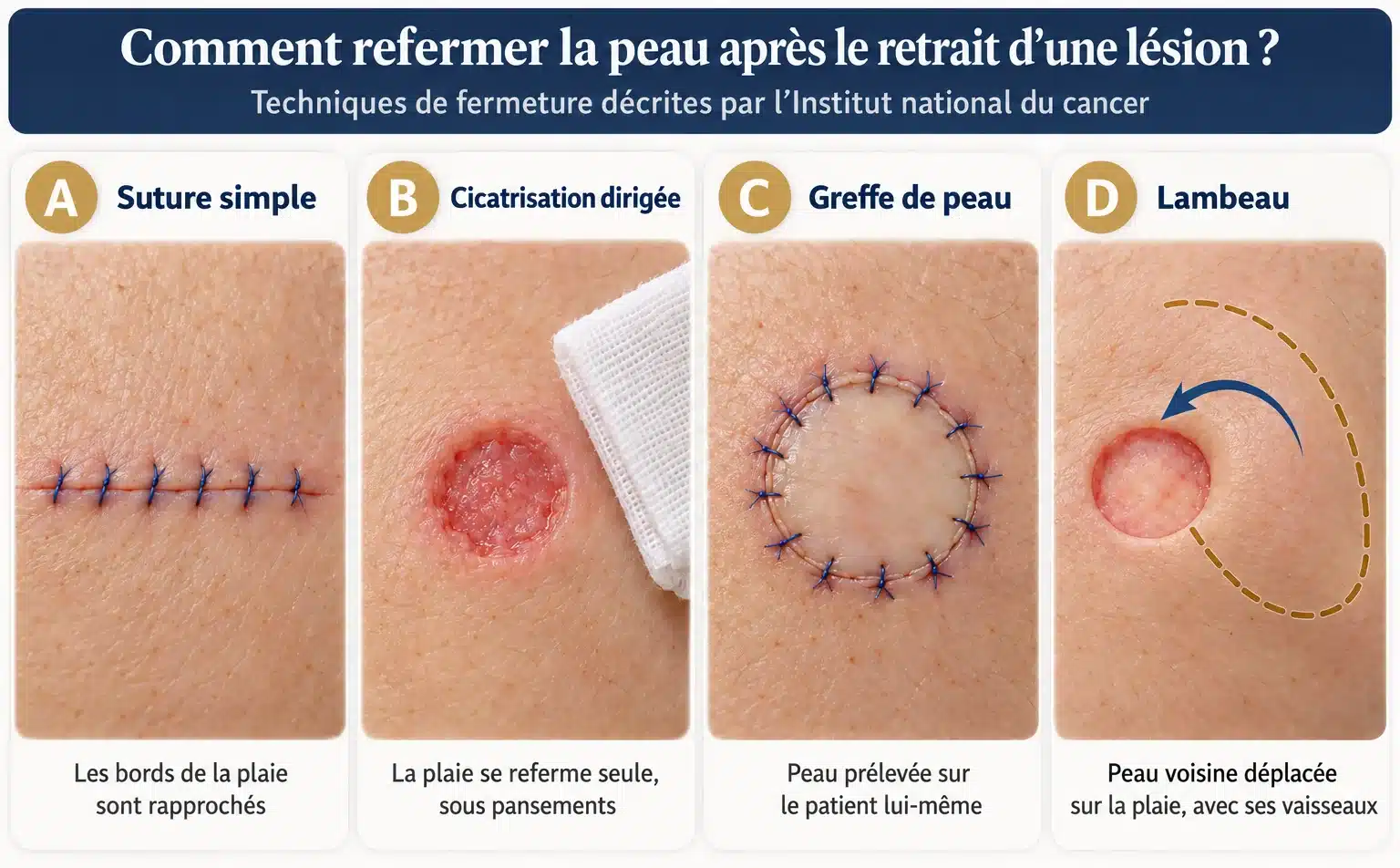
INCa describes several closure techniques [5] :
- la simple suture, which brings the edges of the wound (back, stomach) closer together;
- la directed wound healing under dressings, indicated for example on the tip of the nose or the top of the forehead;
- la skin graft, taken from the patient himself, when the wound cannot be closed directly;
- le shred, more rarely: a neighboring skin, which retains its blood vessels, is rotated to cover the wound.
These procedures carry risks: partial necrosis of a graft (the area then heals under dressings) or of a flap (a further procedure is sometimes necessary), hypertrophic or keloid scarring, more common on the ears, chest, shoulders, knees, and in people with dark skin [5] . The graft can also be performed "by a dermatologist or a surgeon," according to the INCa [5] . See also reconstructive surgery after excision and scar revision.
Do you need to go through your general practitioner to see a dermatologist?
It's not mandatory, but it does change the reimbursement process. The coordinated care pathway involves first consulting your primary care physician, who will then refer you to a specialist if necessary [1] . Some specialists remain directly accessible within this pathway, notably gynecologists and ophthalmologists (provided you have declared a primary care physician), as well as dentists and midwives [1] . Dermatologists and plastic surgeons are not included in this list.
You can therefore book an appointment directly, but you are then outside the standard care pathway: Health Insurance reimburses 30% of the standard consultation fee, compared to 70% within the standard pathway [2] . However, you are reimbursed normally in certain situations, particularly before the age of 16, in emergencies, if your regular doctor is unavailable, or if you are far from home [1].
These rates are based on the standard fee: any additional fees will be your responsibility or that of your supplemental health insurance. According to the INCa (National Cancer Institute), most dermatologists practice this [3] . For procedures performed at the center, see the fees and reimbursements page.
Who decides on the treatment when the lesion is cancerous?
When an analysis confirms skin cancer , the treatment plan is not determined by a single doctor. According to the INCa (National Cancer Institute), the case of every cancer patient must be presented to a multidisciplinary tumor board (MTB) at the start or when their treatment is modified [6] . An MTB brings together at least three specialists from two different disciplines [6] . They issue an opinion; your doctor then presents you with a treatment plan, and your agreement makes the final decision [6].
There is one exception. If the case falls under standard treatment, as defined by an up-to-date guideline, it can be treated without prior discussion, so as not to delay care. The case is then simply recorded in the multidisciplinary team meeting [6].
For basal cell carcinoma, a type of skin carcinoma , the 2023 European guidelines require that "difficult-to-treat" forms be discussed in multidisciplinary tumor board meetings. They also recommend offering surgery with microscopic margin control (micrographic surgery) for high-risk or recurrent forms and those located in critical anatomical areas [8].
For melanoma without metastases, surgery is the standard treatment: a diagnostic excision, then, depending on the thickness of the lesion removed, a safety excision, after a consultation "with the dermatologist or the surgeon" [5].
What signs should prompt a quick consultation?
The French National Cancer Institute (INCa) identifies three warning signs for melanoma: a mole that is "unusual," sometimes called an "ugly duckling"; a new brown spot or a mole that changes rapidly in appearance; and the signs of the ABCDE rule. These signs do not necessarily mean cancer, but they warrant seeking medical advice without delay [4] . The INCa also advises monitoring for any wound that does not heal and any pimple or scab that persists or spreads [4] . The warning signs and the ABCDE rule are detailed in our dedicated article.
TO REMEMBER
When faced with one of these signs, the point of entry matters less than speed: have the lesion examined without delay and do not treat it yourself.
Your situation: who should you see first?
General guidelines, which do not replace medical advice.
| Your situation | First point of contact | If an intervention is necessary | Useful page |
|---|---|---|---|
| A mole that changes or doesn't look like others | General practitioner or dermatologist, without waiting | Excision and analysis, by the dermatologist or surgeon | Removal of a mole |
| A wound or scab that doesn't heal, a persistent pimple | General practitioner or dermatologist, without waiting | Excision and analysis; surgical consultation possible for facial lesions | Treatment of cutaneous carcinoma |
| Numerous moles or risk factors (monitoring) | a dermatologist | Monitoring or withdrawal, depending on the examination | Monitoring moles |
| Annoying skin tag | General practitioner or dermatologist, to confirm the diagnosis | Removal by a dermatologist or surgeon | Skin tag removal |
| Seborrheic keratosis | General practitioner or dermatologist | Withdrawal may be discussed in case of discomfort or doubt | Treatment of seborrheic keratoses |
| Cyst or lipoma (lump under the skin) | General practitioner or dermatologist | Excision by a dermatologist or surgeon, depending on the size and location | Removal of a sebaceous cyst · Lipoma surgery |
| Cancer confirmed to require surgery on the face | The doctor who made the diagnosis; case presented or recorded in the multidisciplinary team meeting | Excision with a margin, then appropriate closure; plastic surgeon if reconstruction is necessary | Reconstruction after skin cancer |
| Scar to be revised | The doctor who operated on you or your dermatologist | Local treatments or surgical revision | Scar treatment |
F.A.Q
Can one go directly to a plastic surgeon to have a lesion removed?
Yes. The consultation is then outside the coordinated care pathway, and therefore less well reimbursed, except in certain cases [1] . If a full skin examination or follow-up seems necessary, the surgeon may also refer you to a dermatologist.
Can a physiotherapist or podiatrist detect melanoma?
It can alert you. With the support of the INCa, physiotherapists and podiatrists are made aware of and trained in melanoma screening. If they have any doubt about a lesion, they will advise you to consult your doctor [3].
Is a photo sufficient for a dermatological opinion?
No, a photo is not a substitute for an examination. In the 2018 Cochrane review, in-office dermoscopy was more accurate than remote interpretation of dermoscopic images [7] . Our online photo analysis tool is an educational resource on the ABCDE criteria, with no medical or diagnostic value: regardless of the result, a lesion that changes, bleeds, or looks different from others must be examined by a doctor.
Who will present you with the proposed treatment in case of cancer?
Your primary care physician, that is, the practitioner in charge of your care pathway. According to the INCa guidelines, it is he who communicates the multidisciplinary team's opinion to you, as part of the notification process. If he proposes a treatment different from this opinion, he must justify it in your medical file [6].
ABOUT THE AUTHOR
Dr. Nathaniel Stroumza-Escoffier is a plastic surgeon in Paris 8, qualified in plastic, reconstructive and aesthetic surgery, former head of clinic-assistant at the hospitals of Paris (RPPS 10100674943). He performs the excision of skin lesions and skin repair.
Office: 11 rue du Faubourg Saint-Honoré, 75008 Paris.
References
- Service-Public.fr (Directorate of Legal and Administrative Information). Primary care physician and coordinated care pathway (fact sheet F163)Verified on August 21, 2026.
- Service-Public.fr (DILA). Co-payment, flat rate and deductibles (sheet F165), verified on April 7, 2026; Reimbursement for a medical consultation (form F1069), verified on December 22, 2024.
- National Cancer Institute. Skin cancer screening: who should you contact? Updated on May 28, 2026.
- National Cancer Institute. How is skin cancer detected? Updated on July 28, 2022.
- National Cancer Institute. Safety surgical excision, updated on July 30, 2025; Melanoma surgery: preparation and procedureUpdated on August 6, 2025.
- National Cancer Institute. The multidisciplinary consultation meetingupdated on July 25, 2025; reference The multidisciplinary consultation meeting in oncology, September 2023, updated in December 2023 (pp. 13-14, 37, 40-41 and 44-45).
- Dinnes J, Deeks JJ, Chuchu N, et al. Dermoscopy, with and without visual inspection, for diagnosing melanoma in adults. Cochrane Database System Rev. 2018;12:CD011902. doi:10.1002/14651858.CD011902.pub2. PMID 30521682. Cochrane systematic review of diagnostic accuracy: 104 publications, 103 cohorts, 42,788 lesions; comparison in consultation: 26 assessments (23,169 lesions) with dermoscopy, 13 assessments (6,740 lesions) with the naked eye alone.
- Peris K, Fargnoli MC, Kaufmann R, et al. European consensus-based interdisciplinary guideline for diagnosis and treatment of basal cell carcinoma—update 2023. Eur J Cancer. 2023;192:113254. doi:10.1016/j.ejca.2023.113254. PMID 37604067. European interdisciplinary consensus recommendation (EADO, EDF, ESTRO, UEMS, EADV).
READ ALSO
This article is for informational purposes only and does not replace a medical consultation.