Sebaceous cyst removal in Paris 8 — Dr. Stroumza-Escoffier
A small, mobile lump under the skin , often on the scalp or face? It could be a sebaceous cyst , a benign lesion caused by a blockage of the sebaceous duct. If it becomes bothersome or painful, surgical removal is recommended.
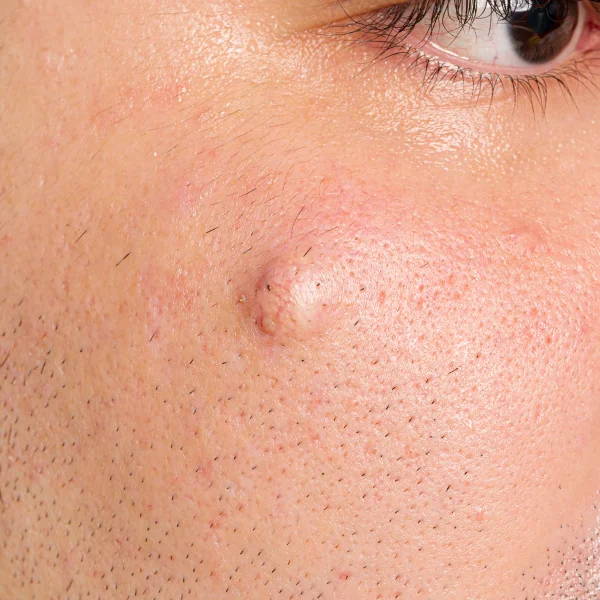
Table of contents
What is a sebaceous cyst?
A sebaceous cyst is an accumulation of sebum under the skin, formed as a result of a blockage in the sebaceous gland duct. It is:
Mobilizable upon palpation
Of varying size (often between 0,5 and 5 cm)
Common on the scalp, face, back or shoulders
It evolves in three phases:
Cold phase : painless, stable
Hot phase : painful, inflammatory
Abscess : an infected cyst requiring urgent intervention
What does the surgical procedure consist of?
Complete removal of the cyst is the only way to prevent recurrence. The surgeon performs a total excision , often under local anesthesia.
In the cold phase:
Cyst marking
Skin incision, removal of the cyst and its capsule
Closure with absorbable stitches
In the hot phase (ablation contraindicated):
We wait for the infection to subside, or we drain it if an abscess has formed. The final removal will take place later.
Should it always be removed?
No. If the cyst is small, painless, and non-inflammatory, it can be left in place. However, excision is recommended in the following cases:
Aesthetic or functional discomfort
History of infection or inflammation
Risk of recurrence or abscess
Is it painful?
The procedure is quick and relatively painless , performed under local anesthesia. A simple dressing and home care are sufficient in most cases.
Are there any scars after removal?
Yes, as with any skin surgery. However, the incisions are small and the scars discreet , especially in the recovery phase. Appropriate post-operative care helps to minimize visible marks.
Follow-up after the intervention
The surgeon prescribes:
A local antiseptic treatment
Sometimes preventive antibiotic therapy
A follow-up appointment in 7 days to check the healing process
The removed sample can be analyzed in the laboratory to confirm the benign nature of the cyst.
Price and refund
The price depends on the technique used, the complexity and the area concerned.
Reimbursement: covered by Health Insurance if the removal is medically justified:
Functional discomfort
Infectious history
FAQ
What are the most common types of cysts?
Sebaceous cyst : skin and scalp
Synovial cyst : near the joints
Ovarian cyst : female reproductive system
Breast cyst : breasts
Pilonidal cyst : intergluteal fold
Is it still benign?
In most cases, yes. But if there is any doubt, a histological examination is recommended to rule out any risk of cancer.
Is it possible to lance a cyst yourself?
No. This increases the risk of infection or recurrence. You should consult a professional.
Can a cyst disappear spontaneously?
Yes, some can resolve on their own (especially breast cysts). But this remains rare.
Does the removal leave a scar?
Yes, but it is usually minimal and well controlled thanks to a clean excision and appropriate post-operative follow-up.
This article is for informational purposes only and does not replace a medical consultation.
The different types of dermatological surgery
A wide range of skin conditions can be treated surgically. The type of procedure always depends on the nature and severity of the lesion.