SOS Dermatological Surgery — Paris. Last updated: July 2026.
Basal cell carcinoma is the most common type of skin cancer . It grows slowly and rarely metastasizes, making it relatively life-threatening—but it never regresses spontaneously and continues to spread locally. And this is precisely where an often overlooked point comes into play: the earlier it is treated, the more limited the surgery, and the less noticeable the scar.
The essential
Treating basal cell carcinoma early means removing a small lesion—that is, performing a limited excision, simple closure, and a thin scar. Waiting allows the lesion to spread: the excision becomes larger and the repair more complex. Early intervention offers both oncological and cosmetic benefits.
What is a basal cell carcinoma?
This is a skin tumor that develops from cells in the basal layer of the epidermis, favored by cumulative sun exposure over the years. It most often appears on sun-exposed areas: face, nose, ears, scalp, and décolleté. Unlike melanoma , it almost never spreads to distant sites; its impact is localized.
Why shouldn't we wait?
Because a basal cell carcinoma doesn't stabilize. As long as it isn't removed, it grows—slowly but surely—and can infiltrate surrounding tissues. On the face, a few millimeters gained near an eye, the side of the nose, or a lip completely changes the difficulty of the repair.
Treating early: a real aesthetic benefit
The standard treatment is surgical excision with microscopic analysis to verify that the lesion has been completely removed. However, the size of the lesion directly determines the outcome:
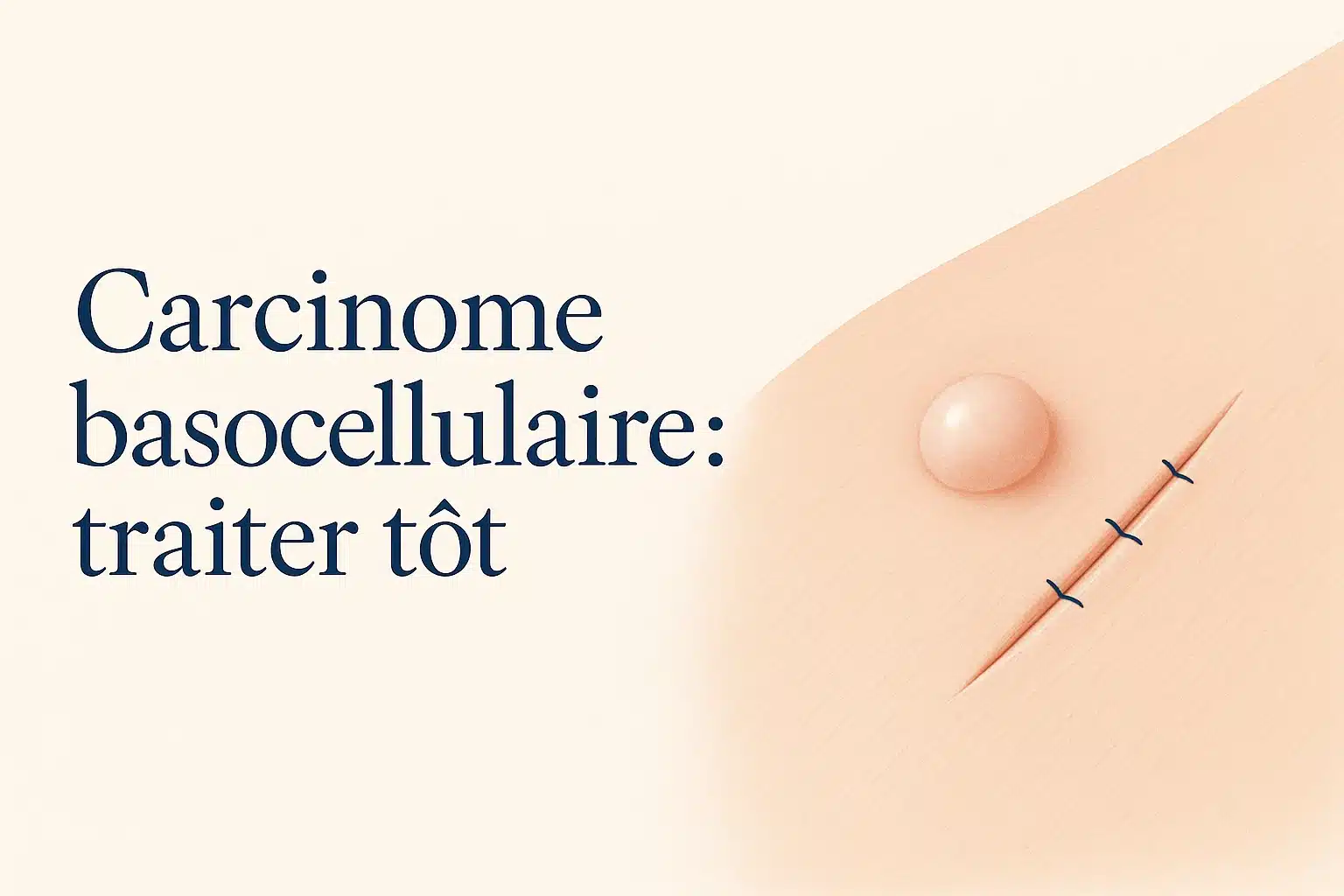
- Minor injury, caught early : excision of a few millimeters, often a direct closure, a fine scar placed in the natural lines of the skin.
- Advanced lesion : wider excision, sometimes requiring a flap or graft for reconstruction, with a scar more extensive.
In other words, the window of opportunity for surgery to remain simple and discreet is at the beginning. This is yet another reason to consult a doctor as soon as a suspicious lesion appears, without waiting for it to "do something."
What signs should raise concern?
Basal cell carcinoma often appears as a small lesion that does not heal. Common signs include:
- a translucent or pearly papule, sometimes traversed by fine vessels;
- a wound or scab that bleeds, heals, then recurs in the same place;
- a small lesion that grows slowly on an area exposed to the sun.
These signs are not specific: only a medical examination, supplemented if necessary by a sample, can provide a conclusion.
How does the care process work?
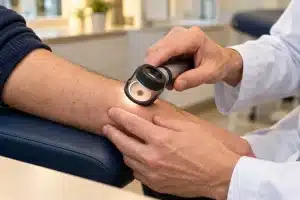
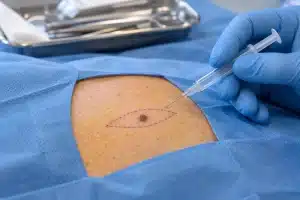
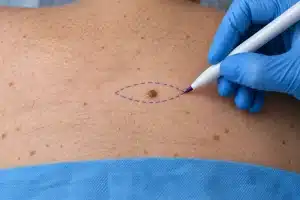
After the clinical examination, the removal is most often performed under local anesthesia on an outpatient basis, as part of dermatological surgery . The specimen is sent to the laboratory to confirm the diagnosis and check the margins. The incision is oriented along the skin's tension lines to minimize the visibility of the scar, as far as the safety of the procedure allows.
When to consult
A lesion that doesn't heal, bleeds intermittently, or grows in a sun-exposed area warrants medical attention. The earlier the treatment, the less noticeable the surgery—and the resulting scar—will be. Schedule an appointment for an examination.
This article is for informational purposes only and does not replace a medical consultation.