They are called “beauty marks” as if they were a trivial detail.
However, these small pigmented spots tell a story: that of our genetics, our sun exposure, and sometimes, more rarely, that of an anomaly to monitor.
In dermatology consultations, the question often comes up:
“Doctor, is this one normal?”
Behind this question lies a legitimate concern: how to distinguish a simple mole from a melanoma?
Why do we have moles?
Moles — or nevi — are localized clusters of melanocytes, the cells responsible for skin pigmentation.
We develop them throughout our lives:
- during childhood
- in adolescence
- sometimes in adulthood
- during hormonal changes
Their number depends primarily on:
- genetics
- of the phototype
- early sun exposure
A fair-skinned person, intensely exposed to the sun during childhood, will often develop more moles.
Not all moles look alike
Some are perfectly regular: round, homogeneous, stable for years.
Others are more irregular, wider, sometimes multicolored.
We then speak of atypical moles.
An atypical mole is not cancer.
But it represents an area requiring careful monitoring.
The key is not just appearance.
It is evolution.
It's not the form that's worrying... it's the change
A mole that has remained stable for 20 years is rarely a cause for concern.
On the other hand, a mole that:
- size change
- changes its color
- becomes asymmetrical
- bleeds
- persistent itching
must be examined.
The so-called ABCDE rule remains a useful guideline, but it never replaces the trained eye of a dermatologist.
Melanoma: why the screening is essential
Melanoma is a skin cancer that originates from melanocytes.
He can :
- appear on a pre-existing nevus
- appear on seemingly healthy skin
His particuliarity ?
It is evolving rapidly.
But when detected early, it is very effectively treated by simple surgical excision.
This is precisely why regular monitoring is fundamental.
The dermatological examination: more than just a look
In consultation, the analysis is not limited to observation with the naked eye.
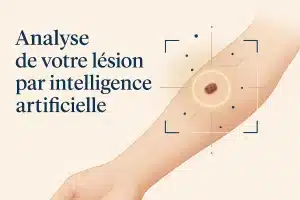
The dermatologist uses a dermatoscope , a magnifying instrument used to analyze:
- the pigmentary structure
- vascular networks
- irregularities invisible to the naked eye
In some patients — particularly those with numerous nevi — photographic mapping may be offered.
It allows us to compare lesions over time and detect the slightest changes.
Should a mole be removed as a precaution?
The answer is nuanced.
A mole is not systematically removed “as a precaution”.
It is removed when it exists:
- a diagnostic doubt
- an evolutionary modification
- repeated trauma
- a significant aesthetic inconvenience
The removal is done under local anesthesia.
The lesion is then systematically analyzed by anatomopathology.
This point is essential:
Any removed pigmented lesion must be able to be examined under a microscope. Learn more about our dermatological surgery.
The laser trap
Occasionally, some patients request laser removal for aesthetic reasons.
In dermatology, this practice is not recommended for suspicious pigmented lesions.
Why?
Because the laser destroys the tissue, preventing any subsequent histological analysis.
Medical caution always takes precedence over technical simplicity.
Can skin cancers be prevented?
You can't change your genetics.
But we can take action regarding sun exposure.
The essential measures:
- Suitable daily sun protection
- avoid prolonged exposure
- ban UV tanning beds
- monitor your skin regularly
Prevention begins in childhood.
What you must remember
The majority of moles are benign.
What should raise concern is not their existence, but their transformation.
Observing your skin, consulting if in doubt and carrying out regular check-ups when the situation requires it remains the best strategy.
In dermatology, early diagnosis saves lives.
About the Author
Dr Nathaniel Stroumza-Escoffier — Plastic and aesthetic surgeon in Paris 8th arrondissement.
Former Head of Clinic at Tenon Hospital (AP-HP), Fellowships in plastic surgery in Brisbane (Australia) and Montreal (Canada). Author of scientific publications indexed on PubMed. First French surgeon trained in MIA prostheses, pioneer of Quantum radiofrequency in France.
RPPS: 10100674943 · → Discover the complete career path (publications, degrees, fellowships)

This article is for informational purposes only and does not replace a medical consultation.