
A melanoma vaccine based on messenger RNA has been undergoing international clinical trials for several years, and the announcements circulating in the press are generating considerable hope among patients. The short answer, to date: this vaccine is not available for routine use, it does not protect against the development of melanoma, and it does not replace screening or surgical removal. In the trials, it is intended for patients who have already undergone surgery for advanced melanoma, to reduce the risk of recurrence. Here's what we know, what remains to be proven, and what this means for you.
Melanoma vaccine: what are we talking about?
The term "vaccine" is misleading. In everyday language, a vaccine is preventative: it stops a disease from occurring. Here, we are talking about a therapeutic vaccine , that is, a treatment administered to a person who is already ill. Its purpose is not to prevent the development of melanoma, but to train the immune system to recognize and eliminate any remaining tumor cells after surgery.
The most advanced candidate, autogenetic intismeran—previously known as mRNA-4157 and V940—is being jointly developed by Moderna and MSD. It is based on the same messenger RNA technology popularized by COVID-19 vaccines, with one major difference: it is personalized . The tumor removed during surgery is sequenced, the patient's specific mutations are identified, and a custom-made messenger RNA is manufactured to train their immune defenses against these precise targets. Therefore, no two patients receive the same product.
In clinical trials, this vaccine is never administered alone. It is combined with an immunotherapy already used in oncology, pembrolizumab, which removes the brakes that the tumor imposes on the immune system. The idea is complementary: immunotherapy opens the door, the vaccine shows the way.
What do the published results show?
Research reached a significant milestone in August 2026. The Phase III INTerpath-001 trial, conducted in 1,137 patients who underwent surgery for stage IIB to IV melanoma, met its primary endpoint: the combination of autogenous intismeran with pembrolizumab prolongs recurrence-free survival compared to pembrolizumab alone. The secondary endpoint of distant metastasis-free survival was also met.
The significance of this result extends beyond melanoma. This is the first positive phase III trial for a personalized messenger RNA immunotherapy in oncology, and the first to demonstrate a benefit superior to pembrolizumab alone in the adjuvant setting, that is, after surgery. These data confirm those of the phase IIb KEYNOTE-942 trial, whose five-year follow-up, presented at the ASCO congress in 2026, reported an approximately 49% reduction in the risk of recurrence or death and a 59% reduction in the risk of distant metastasis or death.
Two caveats are in order. First, these results come from an interim analysis announced by the laboratories; the detailed data still need to be presented at an international conference and published in a scientific journal, the only step that will allow the medical community to fully evaluate them. Second, a positive trial is not an authorization.
As of the date of publication of this article, no melanoma vaccine has received marketing authorization in France, Europe, or the United States. Pharmaceutical companies have announced their intention to begin the application process with regulatory authorities; a request for accelerated approval was rejected by the FDA in 2024. Therefore, the treatment remains accessible only within the framework of clinical trials, according to strict inclusion criteria and in specialized oncology research centers.
Who would this treatment be suitable for?
The trials involve patients who have undergone surgery for melanoma at an already advanced stage, presenting a high risk of recurrence. In other words, the population concerned is very different from the most frequent situation in consultation: that of a suspicious lesion removed early, at a stage where the prognosis is excellent and where no further treatment is necessary.
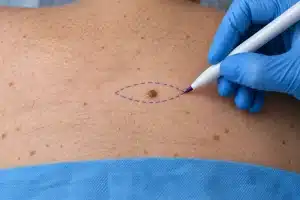
This is a crucial, and paradoxical, point. The more research progresses on advanced forms of melanoma, the more evident it becomes that the determining prognostic factor remains the thickness of the lesion at the time of diagnosis. A thin melanoma, removed early, is treated with simple dermatological surgery . A thick melanoma, diagnosed late, requires intensive treatments, including this vaccine. The difference between the two often comes down to a few months of monitoring.
What this does not change: the priority of screening
However encouraging this research may be, it does not change the current course of action. Mole screening remains the most effective tool at our disposal because it acts where the benefit is greatest: before the lesion thickens.
In practice, three key actions remain paramount. The first is regular self-monitoring, relying on the warning signs of the ABCDE rule : asymmetry, irregular borders, uneven color, increasing diameter, and recent changes. The second is to consult a doctor immediately if any lesion changes, bleeds, itches, or is clearly distinct from others. The third is sun protection, especially for people with fair skin, numerous moles , or a family history of skin conditions.
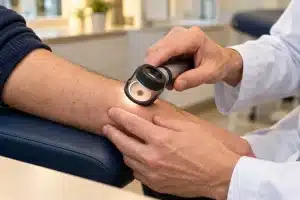
In the office, the examination relies on dermoscopy and lesion mapping, which allows for comparison of images from one consultation to the next and the detection of changes that would be invisible to the naked eye. When a lesion is removed, histopathological analysis remains the only examination capable of confirming or ruling out the diagnosis.
How to follow the progress of this research without making a mistake
Announcements about cancer treatments circulate quickly and often lose their nuances along the way. Three key points help to sort through them. First, the trial phase: a Phase I trial assesses tolerability, a Phase II trial evaluates preliminary efficacy, and only a Phase III trial allows for the possibility of authorization. Second, the study population: a result obtained in stage IV patients does not necessarily apply to an early-stage lesion. Finally, the regulatory status: as long as a product is not authorized, it cannot be prescribed outside of a clinical trial.
If you are being treated for advanced melanoma and are interested in participating in a trial, your referring oncologist will be able to direct you to an investigating center, depending on the stage, the time since surgery and the treatments already received.
F.A.Q
Can this vaccine prevent me from getting melanoma?
No. This is a therapeutic vaccine, intended for people who have already undergone melanoma surgery, and not a preventative vaccine like those given in childhood. Currently, no vaccine protects against the development of melanoma. Prevention relies on sun protection and screening.
Is it available in France?
Not in routine practice. Despite positive Phase III results announced in August 2026, no marketing authorization has been granted to date. The treatment is only available within the framework of clinical trials, in specialized centers, and according to specific inclusion criteria. An additional delay will be necessary between the submission of a regulatory dossier and any potential availability.
If a vaccine becomes available, will surgery become unnecessary?
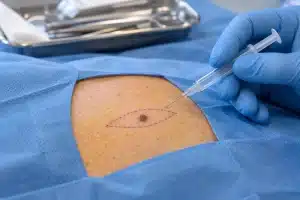
No. In all the protocols studied, the vaccine is administered after surgical removal of the tumor, as a supplement. Excision remains the standard treatment for melanoma, and the quality of this excision determines the subsequent management.
Should we wait for this treatment before having a suspicious lesion removed?
Certainly not. Delaying the removal of a suspicious lesion is the only risk factor over which a patient has direct control. The earlier a melanoma is removed, the less the question of further treatment arises.
Does this technology apply to other types of skin cancer?
The most advanced trials focus on melanoma. Cutaneous carcinomas , which are much more common and have a much better prognosis, require surgical treatment and are not included in these protocols.

This article is for informational purposes only and does not replace a medical consultation.