Introduction
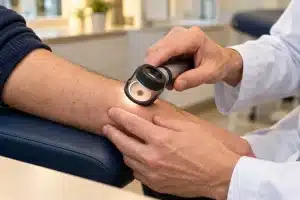
Early diagnosis of melanoma significantly improves the chances of a cure. To help recognize warning signs, dermatologists use the ABCDE rule for melanoma . This visual tool helps assess a mole and differentiate a benign lesion from a suspicious skin cancer.
The ABCDE rule of melanoma
- A stands for Asymmetry A benign mole is regular. An asymmetrical lesion should raise concern.
- B for Edges Blurry or jagged outlines are a suspicious sign.
- C is for Color : a heterogeneous color (several shades) may indicate melanoma.
- D for Diameter : a size greater than 6 mm should be monitored.
- E for Evolution : any rapid change (shape, color, size, bleeding) requires a consultation.
(Image – alt: “ABCDE rule of melanoma for diagnosing skin cancer”)
Why is the ABCDE rule of melanoma essential?
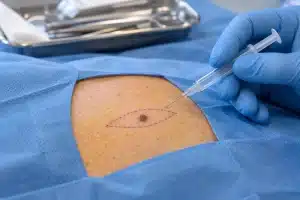
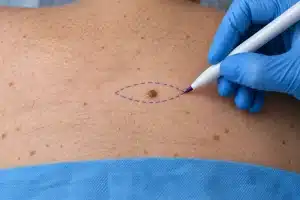
This method allows anyone to quickly detect a suspicious sign. It does not replace medical advice, but it provides a simple and effective warning . If the diagnosis is made early, treatment is generally minimally invasive: simple surgical removal under local anesthesia is often sufficient to achieve excellent results. Learn more about our dermatological surgery.
Prevention and monitoring
- Examine your moles once a month.
- Take photos of your lesions to track their progress.
- Consult a dermatologist as soon as any ABCDE criterion is present.
New technologies, such as the artificial intelligence-based Fotofinder system, further enhance the accuracy of screening.
FAQs about the ABCDE rule for melanoma
How to diagnose melanoma at home?
The ABCDE rule for melanoma is a simple guideline. However, only a dermatologist can confirm the diagnosis.
What is the most important criterion of the ABCDE rule?
Evolution. A melanoma changes rapidly, whereas a benign mole remains stable.
Should I consult if only one criterion is present?
Yes, even a single suspicious sign warrants a dermatological consultation.
About the Author
Dr Nathaniel Stroumza-Escoffier — Plastic and aesthetic surgeon in Paris 8th arrondissement.
Former Head of Clinic at Tenon Hospital (AP-HP), Fellowships in plastic surgery in Brisbane (Australia) and Montreal (Canada). Author of scientific publications indexed on PubMed. First French surgeon trained in MIA prostheses, pioneer of Quantum radiofrequency in France.
RPPS: 10100674943 · → Discover the complete career path (publications, degrees, fellowships)

This article is for informational purposes only and does not replace a medical consultation.